Featured Smart Thermostat Controllers
Precision-engineered, factory-direct smart climate controllers certified for global B2B procurement, HVAC integration, and smart home automation systems.
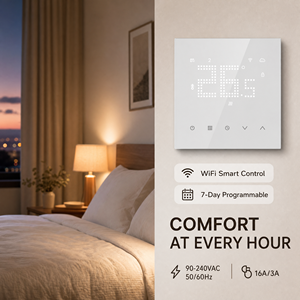
- NTC 10K High-Precision Sensor
- Tuya WiFi / App & Voice Control
- 90-240VAC Wide Voltage Relay
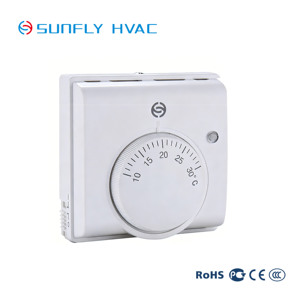
- PID Temperature Loop Algorithm
- Anti-Freezing & Child Lock
- Direct Factory Wholesale Price
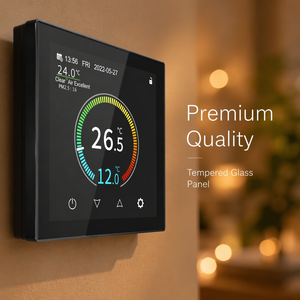
- Full-View Color TFT Interface
- 5+2 / 6+1 / 7-Day Programming
- Dual External/Internal NTC
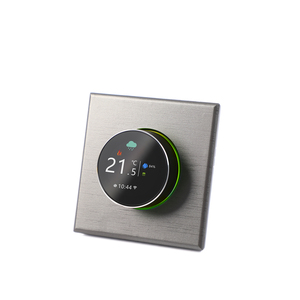
- Tactile Precision Knob Tuning
- Tuya Wireless Mesh / WiFi
- Floor & Ambient Temp Dual Sensing
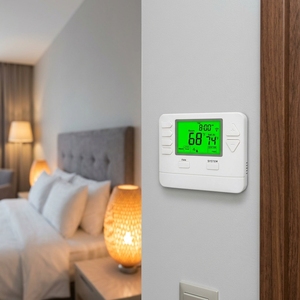
- 24VAC C-Wire Heat/Cool Furnace
- Alexa & Google Assistant Ready
- Energy Star Compliance Logic
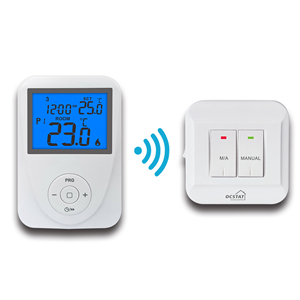
- Long-Range RF Receiver Hub
- Battery Powered Transmitter Unit
- Dry Contact Voltage-Free Relay
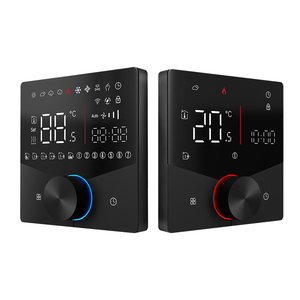
- 3-Speed Fan Coil Control
- Cloud Schedule Synchronization
- Modbus RS485 Optional Port
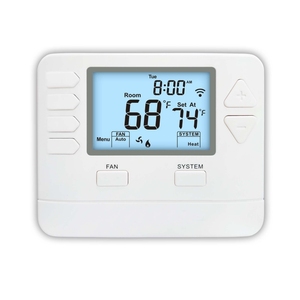
- Multi-Stage Heat Pump Ready
- Flame-Retardant ABS Enclosure
- OTA Firmware Upgrade Capable
The Global B2B Landscape of Smart Thermostat Manufacturing & Control OEM Solutions
The global climate control and home automation industry is undergoing a structural transition. Mechanical bimetallic switches and basic digital controllers are rapidly being superseded by IoT-enabled, cloud-connected smart thermostat control units. For global B2B procurement directors, HVAC system OEMs, regional distributors, and IoT brand owners, partnering with qualified smart thermostat factories is no longer merely a matter of sourcing plastic housings and basic PCB assemblies. It requires a rigorous audit of embedded hardware engineering, wireless protocol stack compatibility, relay endurance benchmarks, and regulatory compliance frameworks across diverse electrical standards.
As search engines shift toward Semantic Search and Search Intent Mining, evaluation criteria for top thermostat factories are evaluated based on tangible engineering capability, proof of EEAT (Experience, Expertise, Authoritativeness, and Trustworthiness), and demonstrable information gain. This industry whitepaper provides an exhaustive technical analysis of smart thermostat factory selection, manufacturing methodologies, circuit topologies, future protocol adoption, and procurement best practices.
Understanding Electrical Systems & System Compatibility in OEM Manufacturing
A primary failure point in B2B smart thermostat sourcing is a misalignment between factory production specs and target market electrical infrastructure. Leading manufacturing facilities engineer modular PCB architectures capable of catering to three distinct global electrical profiles:
| Electrical Topology | Target Region | Operating Voltage | Typical Load Ratings | Primary Heating/Cooling Medium |
|---|---|---|---|---|
| 24VAC Low Voltage C-Wire | North America, Mexico | 24VAC (18-30VAC range) | 1A to 2A per stage (Relay / Triac) | Central Forced Air, Heat Pumps, Gas/Oil Furnaces |
| High Voltage Line Voltage | Europe, UK, Asia, LatAm | 90-240VAC 50/60Hz | 16A Resistive (Electric Underfloor) / 3A (Water Valve) | Electric Heating Cables, Heating Mats, Thermal Actuators |
| Volt-Free Dry Contact | UK, Central Europe | Clean Contact Switch | 3A to 5A Max Switching | Gas Wall-Hung Boilers, Combi Boilers, Pellets |
| DC Bus / RS485 Modbus | Commercial Buildings / VRF | 12VDC / 24VDC / RS485 | Digital Bus Signaling | VRF Central AC, Fan Coil Units (FCU), Chiller Plants |
Top-tier factories utilize automated Surface Mount Technology (SMT) lines equipped with high-speed Yamaha and Panasonic pick-and-place machinery to seamlessly swap voltage regulation components (switching power supplies vs. linear transformers) without altering the master display unit tooling. This modular engineering drastically reduces tooling costs (CAPEX) for OEM partners seeking multi-region market expansion.
Smart Thermostat R&D & Future Product Trends
Key technological shifts reshaping smart HVAC controls over the next 5 to 10 years.
1. Matter 1.3 & Thread Protocol Integration
The IoT industry is rapidly migrating away from proprietary wireless silos toward Matter over Thread. Modern thermostat factories are embedding dual-core SoCs (such as Nordic nRF5340 or Silicon Labs MG24) to enable multi-admin control across Apple Home, Google Home, Amazon Alexa, and Samsung SmartThings without cloud latency or third-party API dependencies.
2. AI-Driven Predictive PID Control Loops
Traditional hysteresis control causes temperature overshooting and energy wastage. Future-ready manufacturing units feature on-chip Proportional-Integral-Derivative (PID) and Fuzzy Logic algorithms. By sampling ambient NTC thermal resistance at 100ms intervals, smart controllers predict thermal inertia, reducing heating energy consumption by up to 26.4% annually.
3. OpenADR 3.0 & Grid-Interactive Response
With utility companies incentivizing peak-demand shaving, commercial and residential thermostats are evolving into smart grid nodes. Factories are implementing OpenADR 3.0 protocol clients directly into firmware, allowing thermostats to automatically adjust setpoints during peak energy pricing windows.
4. Advanced HMI: Glass Touch & e-Paper Displays
Consumer aesthetics demand seamless integration with modern interior architecture. Standard TN/STN LCD screens are being replaced by high-contrast IPS LCD panels, capacitive glass touch surfaces with anti-fingerprint oleophobic coating, and ultra-low-power electronic paper (e-Paper) displays for battery-operated wireless room units.
5. Integrated Indoor Air Quality (IAQ) Sensing
Temperature control is converging with holistic environmental monitoring. Advanced factories are co-packaging NTC temperature sensors with solid-state CO2 NDIR sensors, TVOC gas sensors, and capacitive humidity sensors inside the thermostat housing, providing single-pane-of-glass climate automation.
6. Zero-Trust Embedded Cybersecurity
As smart home devices become targets for network intrusion, regulatory bodies (such as the EU Cyber Resilience Act and US Cyber Trust Mark) mandate hardware-level security. Leading factories incorporate Secure Elements (ATECC608A / PSA Certified Level 2) with hardware root-of-trust, encrypted bootloaders, and TLS 1.3 cloud communication protocols.
Future B2B Procurement & Supply Chain Trends for Thermostat Buyers
Sourcing smart thermostat controls has evolved from cost-per-unit negotiation to long-term risk mitigation and hardware-software co-design. Strategic B2B buyers must align with factories capable of navigating key macroeconomic and technical shifts:
A. Microcontroller Platform Standardization vs. Dual-Sourcing
The semiconductor shortages of recent years taught global buyers the vulnerability of single-chip firmware architectures. Advanced factories now design mainboards using Pin-to-Pin Compatible MCU Abstraction Layers. By building hardware abstraction layers (HAL) into firmware, a factory can switch production from Espressif ESP32, Realtek RTL8720, or Bouffalo Lab chipsets within 3 to 4 weeks without requiring complete PCB redesigns or re-certification.
B. Factory Compliance Beyond ISO9001: ESG & Carbon Footprint Audits
Major European and North American importers are now required to audit Tier-1 and Tier-2 manufacturing facilities under Supply Chain Due Diligence Acts. Leading smart thermostat controllers are engineered under ISO14001 (Environmental Management) and ISO45001 (Occupational Health) frameworks. Raw material supply chains are verified for halogen-free PCBs, lead-free SMT solder paste (RoHS compliance), and recyclable ABS/PC plastic resins.
C. Turnkey White-Label SDKs & Cloud Agnostic Firmware
Hardware buyers no longer want to be locked into proprietary factory mobile apps. Premier OEM factories supply turn-key software development kits (SDKs) for iOS and Android, API webhooks, and pre-certified Tuya / Smart Life / HomeKit / MQTT cloud pipelines. This allows brand owners to deploy custom branded applications while leveraging proven, enterprise-grade cloud server infrastructure.
Factory Expertise & Manufacturing Capability Benchmark
Building on over 15 years of precision consumer electronics and intelligent home automation engineering (originating from our group's heritage in high-reliability electronic design), our specialized thermostat manufacturing facilities provide an end-to-end OEM/ODM partnership model.
In-House Mold Engineering
Over 80 high-precision CNC molding machines and EDM tooling equipment capable of taking custom plastic housing concepts from 3D CAD renders to T1 plastic samples in under 21 days.
Automated SMT & AOI Testing
Fully automated High-Speed SMT production lines with 3D Automated Optical Inspection (AOI) and In-Circuit Testing (ICT) ensuring 100% component placement accuracy and solder joint reliability.
Reliability & Environmental Labs
On-site testing facilities including environmental climate chambers (-40°C to +85°C), ESD immunity generators (up to 15kV), relay contact load endurance testers, and drop/vibration simulation rigs.
Our engineering team works as an extension of your product management team—handling schematic design, multi-layer PCB layout routing, thermal dissipation management, antenna tuning (RF 433/868MHz, WiFi, Bluetooth, Thread), firmware programming, packaging design, and international regulatory certification filings (UL, CE, FCC, RED, RoHS, REACH).
Frequently Asked Questions (FAQ) for Smart Thermostat Sourcing
Essential technical and logistical answers for B2B procurement officers, HVAC brand managers, and OEM partners.
Partner With a Leading Smart Thermostat Factory Today
Request our complete 2025 OEM/ODM Product Catalog, detailed engineering specifications, factory audit documentation, and wholesale B2B pricing schedules.
Get Catalog